
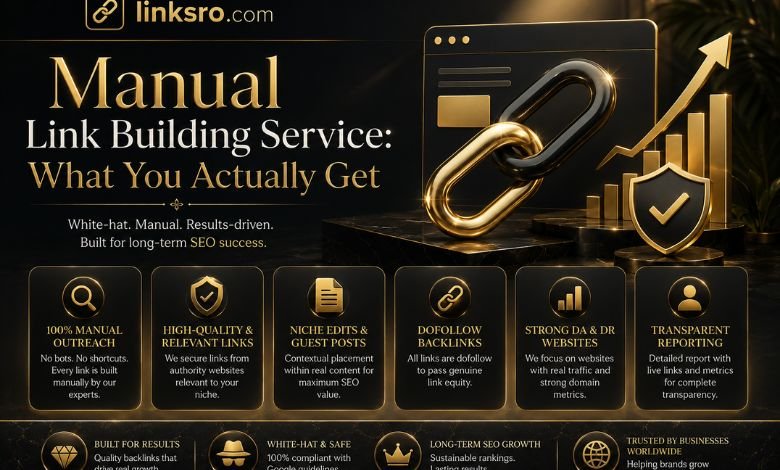
Manual Link Building Service: What You Actually Get
Learn what a manual link building service includes, from real outreach and quality backlinks to costs, timelines, and SEO results.
I’ve watched this story play out more than once. A business owner finds a listing for “100 manual backlinks” at fifty bucks. The seller promises high-authority sites, a full report, and fast rankings. Weeks later, the owner has a spreadsheet of junk profile pages and a traffic graph that hasn’t moved.
The lesson stuck with me: anyone can print the word “manual” on a sales page. Doing the work is another story.
If you’re shopping for a manual link building service, this guide covers what you’re really buying, what it costs, and how to dodge the most common traps.
A manual link building service uses real people to earn backlinks through personalized outreach. Expect to remunerate roughly$ 150–$ 500 per standard placement( more for high- authority sites), wait about 3– 6 For months meaningful results, and on- demand sites and clear reporting before you commit.
What Is a Link Building Service?
Let’s start with the question people ask most: what is a link building service?
It’s a done-for-you offering. A team earns or places backlinks to your website for you. A backlink is simply a link from another site to yours.
Search engines treat those links a bit like referrals. When a respected food blogger recommends your restaurant, people listen. When a stranger shouts about it from a parked van, nobody does.
A link building service handles the heavy lifting. The team finds relevant sites, contacts editors, creates content, and gets your link live. You skip the hours of prospecting and outreach emails.
What Makes a Link Building Service “Manual”?
A manual link building service relies on real people doing real outreach. It doesn’t use any robots, no. Forum spam, no private blog networks.
Evaluate the difference between a handwritten letter and a mass mailer. Both reach the mailbox, but individuals review only one.
In practice, a human:
- Researches sites that fit your niche and audience
- Writes a personalized pitch to a real editor or site owner
- Creates content worth publishing
- Checks each placement after it goes live
Reputable providers explain their process much the same way. For sample, significant- quality, personalized access is called the cornerstone Of effective manual link building, And other agencies Stress relevance and quality over volume. Use it as your benchmark when you compare them.
What’s Actually in the Box?
A good campaign involves far more than sending emails. Most include:
- Strategy And to expect: The team Finding sites that create sense. Your business, Not only any site with a big authority score.
- Outreach: They Pitch editors, bloggers, and site owners.
- Content creation: They write. The guest post, resources, or pitch asset.
- Location: They progress the link Reside on a factual, indexed page.
- Reporting: They Exhibit you exactly where every link went off
Some providers also let you choose your level of control. One outreach agency offers both pre-approval and non-approval options. With pre-approval, you sign off on each site first. With non-approval, the team moves faster.
Neither option wins automatically. If you guard your brand closely, pre-approval is worth the extra time.
Link Types You’ll Meet
You’ll see these terms again and again:
| Link type | How it works | Often suits* |
| Guest posts | You (or the agency) write an article for another site and earn a link back | Most small businesses |
| Niche edits | The team adds your link to an existing article that’s already published and indexed | Faster placements |
| Digital PR | You create newsworthy content or data that journalists want to cover | Brand building |
| Broken link building | You alert a site owner to a dead link and offer your page as the replacement | Content-rich sites |
| Resource page links | A curated “best resources” page lists your content | Evergreen guides and tools |
*These are general rules of thumb from industry experience, not hard rules.
I’m partial to digital PR for brand building, but it costs more and moves slower. Guest posts The rest are the workhorse For the most part small businesses.
Earned vs. Paid Placements: The Part Most Guides Skip
Here’s where many buyers get tripped up, so let’s be direct.
Google explains link spam as a link to or from a site Mainly for manipulation search rankings, And its examples Buy or commercialize links for ranking purposes and exchange currency for links or posts containing links. But at the same time, Google recognizes that links are bought and sold. A normal part of the web’s economy for advertising and sponsorship, and it’s fine until then. Those links remove a nofollow or sponsored attribute.
What does that mean for you?
- Genuinely earned links( an editor links Because you your content deserve it) sit comfortably inside. The guidelines.
- Paid or sponsored placements are acceptable when properly branded, but a branded link may not pass the ranking value. The way you hope Paid links that pass ranking credit without labels. Google Goal Its link spam policy I also cover keyword based links. Guest posts and press releases.
Google It also actively fights. In its December 2022 link spam update, He said he used SpamBrain To ascertain out both sites to buy links and sites Transfer and neutralize outgoing links the impact Of unnatural links. Practically, risky links Often it is quietly ignored rather than punished. You’ve Paid nothing, that is a quieter kind of loss.
So when you check. A provider, Ask directly: How do you handle the sponsorship? links and disclosure? How do you obtain a placement? What if a link becomes neutral? A good provider answers plainly.
What Does It Cost?
Come again talk about money, since most articles dodge the subject.
Prices vary a lot, and most public benchmarks appear from vendor- run surveys, so treat them as industry estimates. This is it. A snapshot Of 2026 figures:
| Placement type | Typical range (USD) |
| Cheap bulk packages | A few dollars per link (usually where the junk lives) |
| Niche edit on a mid-authority site | About $150 to $350 on a DR 50 site |
| Standard guest post | About $250 to $500 on a comparable domain |
| Quality guest post, high authority | About $692–$957 before vendor markup |
| Digital PR | Around $750 per link on average |
For a broader benchmark, a March 2026 survey of 518 SEO professionals put the average cost of a high-quality backlink at $508.95, and links from authority sites can cost $1,500 or more.
Several factors push the price up or down:
- The authority and traffic of the sites (often measured by DR or DA)
- How niche your industry is
- Whether content creation comes included
- How much approval control you want
Here’s an analogy I like. A $5 link is like a $5 parachute. You might get lucky, but I wouldn’t bet my weekend on it.
My Five-Point Vetting Test (The Used-Car Method)
When I buy a used car, I don’t just admire the paint. I pop the hood. A link building provider deserves the same scrutiny:
- Ask for real examples. Request named sites, live URLs, and actual placements. If they refuse, walk away.
- Check relevance. Does the site fit your industry, or does it cover everything under the sun?
- Inspect the site itself. Look for real traffic, real content, and real readers. A high authority score on a dead site is a polished car with no engine.
- Understand the reporting. You should see where every link lives and what you paid for.
- Read the fine print on guarantees. Nobody can credibly guarantee rankings.
Red Flags to Watch For
Remember the fifty-dollar story? Listings like it lean on the usual phrases. One marketplace gig, for example, promised “100% manual” work, high-DA links, “100% Panda, Penguin & Hummingbird safe” placements, and a “100% ranking result”, while the same page noted that SEO providers can’t guarantee results. When a listing contradicts itself like that, take the hint.
Watch for these warning signs:
- Guaranteed rankings or instant results
- Unnamed sites (“trust us, they’re high authority”)
- Suspiciously low prices for large volumes
- Mentions of PBNs or “private networks”
- Vague reporting
- No clear answer on how sponsored links are handled
How Long Until You See Results?
Here’s the honest answer, even if you don’t want to hear it: link building is a slow burn, not a firework.
Estimates vary. One agency says it typically takes two to six months to see a meaningful ranking increase on competitive keywords, while others say anywhere from 3 to 12 months. A good planning range is 3–6 months, with longer timelines for competitive terms. In low-competition niches, you may see movement sooner.
Think of it like planting a garden. You can’t yell at the seeds. You water, you wait, and you trust the process. And don’t cancel in month two because the graph looks flat. That’s often right before things start compounding.
Is a Manual Link Building Service Worth It?
To many businesses, Yes, as long as you choose the right partner and the seat realistic expectations. You settle for duration, relationships, and judgment, and it’s demanding to automate them.
The math matters too. If your competitive niche calls for something like an $8,406 average minimum monthly budget, that buys roughly 16 links at the average price above. Make sure your business case supports that before you sign.
Links also work best as part of a bigger plan. Great content, a technically sound site, and solid on-page SEO multiply the value of every link you earn. Links are the megaphone, not the message.
Quick FAQ
Is manual link building safe?
It’s lower- risk Compared to automated schemes, however, it is not risk- free. Stay relevant, editorial placements But real sites, And ensure that all payment placement is done transparently. Observe the section above On earned vs paid links.
How many links do I need for a fee? month?
It depends. Your competition. Quality usually beats quantity, so start studying it. Your top competitors are earned.
Can I do it myself?
Yes, it just takes a lot of time. Many people outsource when they witness how much work outreach includes.
Key Takings
- If I could provide one piece of advice for anyone buying links, this is it: pay for the decision, not just the links.
- A solid manual link building service shows its work, talks clearly about costs and risks, and never promises miracles. Find out.
- One Thus, and you acquire a real partner instead of a spreadsheet of regrets.
Additional Resources
- Google Search Central: Spam Policies (https://developers.google.com/search/docs/essentials/spam-policies). Google’s own guidance on link spam and what to avoid.
- Google Search Central: Qualify Your Outbound Links (https://developers.google.com/search/docs/crawling-indexing/qualify-outbound-links). Explains the nofollow, sponsored, and ugc link attributes.